
Taking Your Caravan Abroad in 2026: The New Registration Rules UK Owners Need to Know
Planning to tow your caravan into Europe? Updated DVLA guidance means many UK caravans over 750kg must now be registered separately before travelling through most European countries.
This is updated guidance, not one entirely new 2026 law
You may have seen this described as a “new caravan law for 2026.” The underlying UK trailer-registration system has existed for several years, but DVLA guidance was significantly updated in August 2025.
That updated guidance now states that all trailers over 750kg, including private touring caravans, must be registered before being driven to or through most countries in Europe.
Rules and travel systems can change. Check current GOV.UK, destination-country and European Union guidance before every journey.
Taking a caravan abroad can be one of the most rewarding ways to explore Europe. You can travel at your own pace, stay in several regions and enjoy the familiarity of your own living space throughout the journey.
However, travelling internationally with a caravan requires more preparation than a normal UK touring trip. In addition to passports, insurance and destination-specific driving rules, many caravan owners must now complete a separate DVLA trailer registration.
Once registered, the caravan receives its own trailer registration number. This is different from the registration number of the tow car and must be displayed on a separate white plate.
You must also carry the physical trailer registration certificate so it can be shown to a foreign authority if requested. Failing to meet the applicable registration requirements could result in enforcement action abroad.
The main points at a glance
What has changed for private caravan owners?
Earlier information about the UK trailer registration scheme focused heavily on commercial trailers and trailers exceeding 3,500kg.
Updated DVLA guidance now states that all trailers over 750kg must be registered before being driven to or through most European countries. The guidance specifically confirms that this applies to both commercial and non-commercial trailers, including caravans.
Most full-sized touring caravans exceed 750kg, so the rule is relevant to a large proportion of UK caravan owners planning a European journey.
The important figure is the caravan’s permitted gross weight. For caravans, this will commonly be shown as the Maximum Technically Permissible Laden Mass, or MTPLM.
Do not use the caravan’s empty weight when deciding whether the rule applies. Check its weight plate, handbook, CRIS documentation or manufacturer’s information.
If the caravan’s MTPLM is over 750kg and your route includes a country covered by the scheme, complete the registration before departure.
Which European countries require registration?
GOV.UK says trailers over 750kg must be registered before travelling to or through most European countries.
The published list includes popular touring destinations and transit countries such as France, Belgium, the Netherlands, Germany, Italy, Austria, Portugal, Switzerland, Norway, Denmark, Sweden, Greece and many countries in Central and Eastern Europe.
Registration is not currently required for trailers used only in the UK, journeys between the UK and Ireland, or trailers used in Cyprus, Malta or Spain.
The route matters as much as the final destination. Spain is listed as an exception, but a caravan travelling from the UK to Spain by road will normally travel through France. Since France is covered, the caravan must be registered for that part of the journey.
The same principle applies when reaching Malta or Cyprus through another covered country. Check every country you will enter, including brief transit stops.
Spain itself is listed as an exception, but registration is still needed because the caravan is being towed through France.
How to register your caravan with DVLA
The registration is completed through the official GOV.UK trailer registration service. You will need a Government Gateway account, although one can be created during the application process.
Details requested may include the caravan’s VIN, chassis or CRIS number, manufacturer, gross weight, unladen weight and trailer type.
If a separate gross weight is not shown, the caravan’s MTPLM can be used. If an unladen weight is not specified, its Mass in Running Order, or MIRO, may be accepted.
The current fee for first registration is £26. After registration, DVLA sends an immediate confirmation email containing a trailer number-plate authorisation certificate.
A physical trailer registration certificate is then posted, normally within three to five working days. The certificate is valid for ten years, but the keeper and caravan information must remain accurate.
Locate the VIN, CRIS or chassis number and weight figures.
Use the official GOV.UK trailer registration service.
Take the authorisation to a registered number-plate supplier.
Keep the physical certificate with the caravan abroad.
What does the separate trailer plate look like?
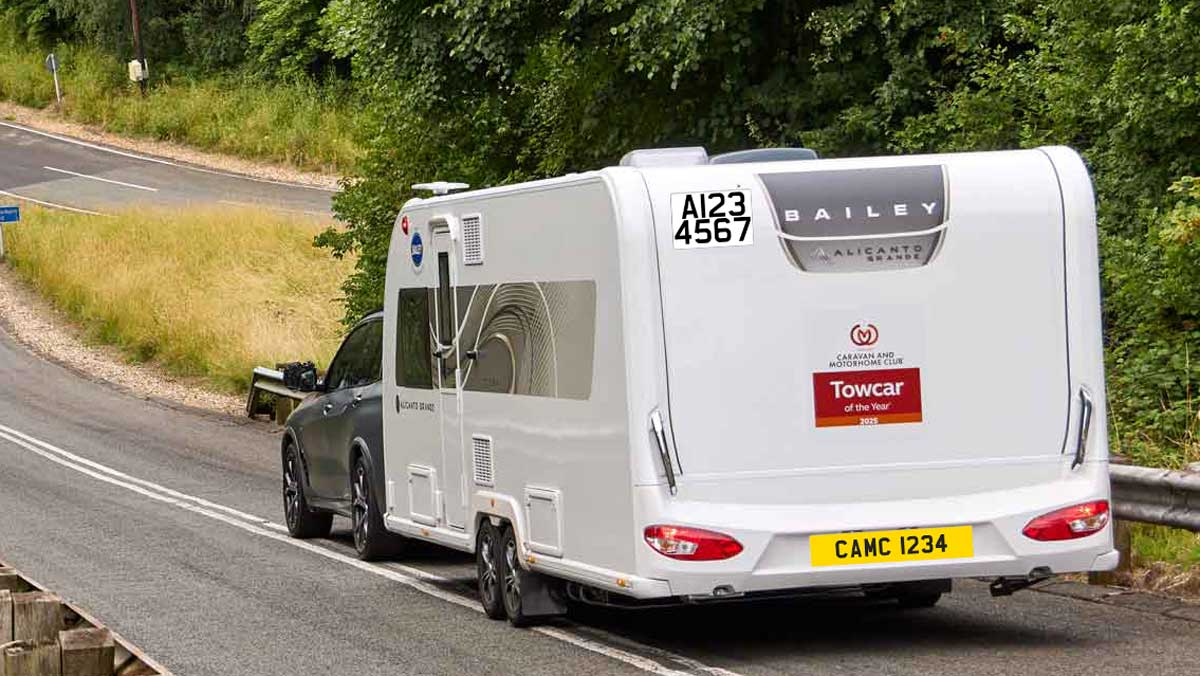
The trailer registration number is issued by DVLA and follows a different format from a normal car registration. It consists of one letter followed by seven numbers, normally arranged over two lines.
The plate has black characters on a white background and is similar in shape to a motorcycle registration plate.
It must normally be fitted vertically at the rear of the caravan where it is clearly visible. It is displayed in addition to the registration plate matching the towing vehicle.
The two plates should be positioned as far apart as reasonably possible. If the trailer plate cannot be displayed at the rear, separate plates may need to be fitted visibly on both sides.
The plate must be made by an authorised supplier and must not be obscured, altered or decorated in a way that makes it difficult to read.
A caravan travelling under the scheme displays both the normal plate matching the tow car and its own separate trailer registration plate.
Do you also need a UK sticker?
DVLA guidance says some foreign countries may require a UK sticker on the trailer and recommends displaying one to reduce the risk of enforcement problems abroad.
The UK identifier should be a separate sticker or sign positioned near the trailer registration plate. It must not be printed or placed directly onto the trailer registration plate.
Check the rules for both the tow car and caravan before departure. Requirements may differ depending on what national identifier is already displayed on the vehicle’s registration plate and which countries are being visited.
Remember that the identifier changed from GB to UK. An old GB-only sticker should not be relied upon.
Which documents should caravan owners carry?
The separate trailer registration certificate is only one part of the paperwork required for an international caravan journey.
Carry your valid passport, driving licence, vehicle registration document, motor-insurance evidence, caravan insurance documents and breakdown cover details.
You should also have the caravan’s registration certificate, CRIS or ownership information, campsite bookings and any documents required by the countries on your route.
A UK photocard driving licence is accepted for many common European destinations without an International Driving Permit. However, the requirement depends on the destination, licence type and sometimes the issuing territory.
Holders of older paper licences may face different rules. Check the official International Driving Permit guidance for every country on the itinerary.
- Valid passport
- Driving licence
- Travel insurance
- Health documentation where relevant
- Vehicle V5C registration document
- Motor-insurance evidence
- Breakdown-cover details
- International Driving Permit if required
- Trailer registration certificate
- Caravan-insurance evidence
- CRIS or ownership information
- Service and recovery details

Check your motor and caravan insurance
UK vehicle insurance provides the minimum third-party cover needed to drive in the EU, including Ireland. A motor-insurance Green Card is not normally required for driving in the EU, Andorra, Bosnia and Herzegovina, Iceland, Liechtenstein, Norway, Serbia or Switzerland.
Minimum legal cover may be very different from the protection you expect. Contact the motor insurer to confirm that towing is covered and that the policy provides the desired level of European cover.
Caravan insurance is normally separate from the tow-car policy. Confirm that the caravan policy covers every country being visited, international recovery, theft, accidental damage and the length of the planned trip.
Breakdown cover should specifically include both the tow car and caravan. Check any limits relating to caravan length, weight, age or repatriation costs.
Save emergency telephone numbers somewhere accessible outside the caravan as well as inside it.
EES and ETIAS: two different European travel systems
Caravan owners may also hear about the Entry/Exit System, known as EES, and the European Travel Information and Authorisation System, known as ETIAS.
EES is a digital border system for non-EU nationals making short visits to participating European countries. It records entry and exit information and may collect biometric information such as a facial image and fingerprints.
The phased EES introduction ended in April 2026, meaning it is now fully operational at the external borders of participating countries. Allow additional time for border formalities, particularly during busy travel periods.
ETIAS is different. It will be a pre-travel authorisation for visa-exempt visitors to participating European countries. The official EU timetable currently says it is expected to begin in the final quarter of 2026.
No ETIAS application is required at present. The EU says it will announce the specific start date in advance. Use only the official EU application service once it becomes operational and avoid unofficial websites claiming that applications are already open.
A border entry-and-exit recording system. Registration takes place as part of border processing.
A pre-travel authorisation. No application is currently required.
Registration is not the only rule to check
Registering the caravan does not automatically make the entire outfit compliant in every destination.
Each country can set its own towing speed limits, safety-equipment requirements, low-emission zones, toll systems, parking rules and restrictions on caravan access.
Equipment such as warning triangles, reflective jackets, headlamp adjustment, spare bulbs or environmental stickers may be required or strongly recommended depending on the country.
Speed limits may also change according to the combined weight of the car and caravan, the road type or local weather conditions. Never assume the UK towing limit applies abroad.
Research the current official rules for every country on the route, not just the destination. Sign up for FCDO travel updates where appropriate.
Prepare the caravan before a long European journey
International travel often means longer distances, higher motorway speeds and warmer conditions than a typical UK touring trip.
Check the tyres carefully, including age, pressure, condition and load rating. Caravan tyres can deteriorate through age even when their tread appears substantial.
Inspect the wheel fixings, brakes, breakaway cable, coupling, lights, number plates and towing electrics. Confirm that windows, rooflights, lockers and internal loads are secure.
Weigh the caravan when loaded for travel and remain within its MTPLM. Heavy items should be kept low and close to the axle where appropriate, with the noseweight checked against the limits of the car, tow bar and caravan.
A service or professional pre-travel inspection can provide useful reassurance before a major journey, particularly where the caravan has been stored for several months.
Your 2026 European caravan checklist
- Confirm the caravan exceeds or falls below 750kg
- Check every destination and transit country
- Complete DVLA trailer registration where required
- Order and fit the separate white trailer plate
- Carry the physical registration certificate
- Display a separate UK sticker where appropriate
- Check passports and validity requirements
- Carry driving licence and V5C
- Check whether an IDP is needed
- Confirm motor and caravan insurance
- Arrange suitable European breakdown cover
- Monitor current EES and ETIAS information
- Inspect tyres, brakes and wheel fixings
- Test lights and towing electrics
- Check coupling and breakaway cable
- Confirm MTPLM and loading
- Secure lockers, windows and internal items
- Book servicing or inspection where required
- Check local towing-speed limits
- Research toll and low-emission schemes
- Carry compulsory safety equipment
- Check campsite and overnight-stop rules
- Save insurer and recovery numbers
- Review official advice immediately before travel
Common mistakes to avoid
Registration and equipment rules may apply in countries you travel through.
Registered caravans need their separate white trailer plate as well as the tow-car registration plate.
Foreign authorities may request the physical trailer registration certificate.
An overland route through France still brings the caravan into a country where registration is required.
ETIAS is not yet operating. Avoid unofficial sites claiming that an application is currently required.
Registration does not replace country-specific towing, toll, equipment or low-emission requirements.
Check the latest guidance before travelling
This article was reviewed against official UK government and European Union guidance available in July 2026. Requirements may change after publication.
Register early and prepare the complete journey
For many UK caravan owners travelling abroad in 2026, the most important change is the need to register a caravan over 750kg before towing it into or through most European countries.
Registration brings three practical requirements: fit the separate trailer registration plate, continue displaying the plate matching the tow car and carry the physical registration certificate.
Look beyond the final destination and check every transit country. Confirm the latest insurance, driving-licence, border and destination requirements immediately before departure.
The Active Leisure team can help customers prepare their caravan mechanically for a major journey, but official registration and travel decisions should always be checked directly with GOV.UK and the relevant destination authorities.